Want the occasional useful email?
New calculators, updated cost data, and the occasional money-saving guide. No account needed, and you can leave any time.
By Alex Diaz · How we calculate this
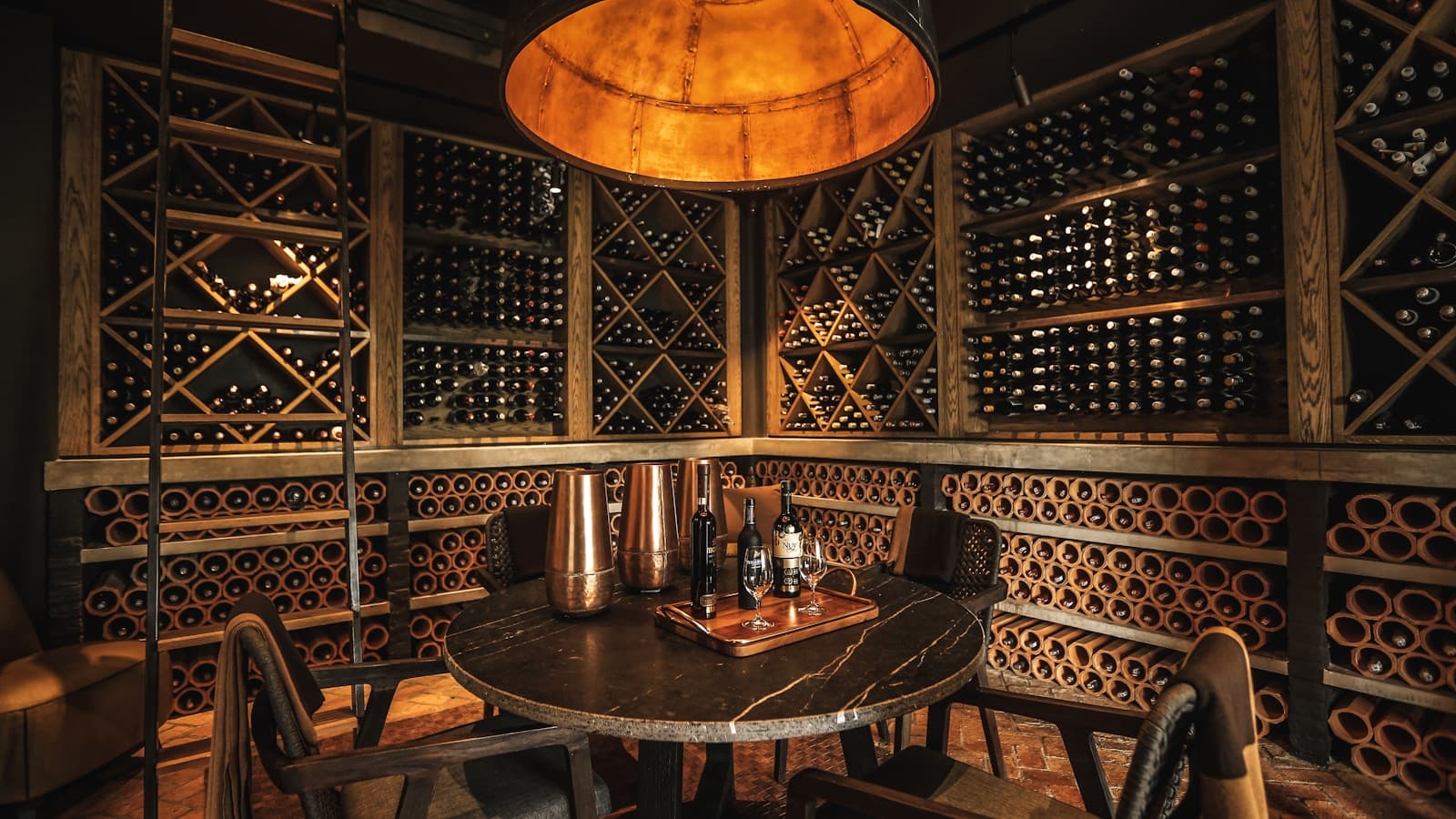
A cooling unit retrofit into an existing closet or basement nook can run a few thousand dollars; a fully custom-built cellar room with insulation, racking, and a sealed door tends to run five figures. That gap exists because wine actually needs the conditions a cellar provides: steady temperature around 55-58 degrees, humidity in the 60-70% range, and no light or vibration, or it degrades instead of improving with age. Collections large enough to matter can be insured with a dedicated rider, which most standard homeowners policies won't cover on their own.
These key factors affect wine cellar affordability
Cooling unit and construction
A standalone wine refrigerator or a cooling unit dropped into a converted closet runs $1,000-3,000. Go the custom route instead, with real insulation, a dedicated cooling system, racking, and a sealed door, and the build climbs to $8,000-25,000 or more depending on room size.
Racking and capacity
Racking gets priced per bottle of capacity, not as a flat fixture, typically $50-150 a slot in custom wood or metal. Scale that up to a 500-bottle cellar and racking alone can hit $10,000-25,000, often rivaling the cooling system as the single biggest line item in the whole build.
Climate control requirements
Hold the room at 55-58 degrees and 60-70% humidity or the wine ages badly instead of well, which is the entire point of building a cellar in the first place. Sizing the cooling unit to the actual room, not a generic estimate, matters here; an undersized unit runs constantly, wears out early, and still struggles to hold humidity steady.
Initial wine collection cost
Building the room and filling it are two separate budgets. A starting collection worth protecting in a climate-controlled space typically adds several thousand dollars beyond whatever the build-out itself cost, and that number climbs fast once you're chasing anything collectible rather than everyday drinking wine.
How to use your results
- Separate the cellar construction cost from what you plan to spend stocking it with wine, since these are two distinct budgets.
- Size your cooling unit to your actual space, since an undersized unit is a common and costly mistake.
- Include racking costs per bottle of planned capacity, since this can be a larger cost driver than the cooling unit itself.
- Recheck your total if converting an existing space versus building a dedicated addition, since the latter adds significant construction cost.
Ways to increase how much wine cellar you can afford
- Convert an existing closet or basement space instead of building a dedicated cellar addition, saving significantly on construction.
- Choose a standalone wine refrigerator instead of a fully built-out cellar if your collection is under 200 bottles.
- Use simpler modular racking systems instead of custom-built wood racking to cut a major cost driver.
- Build out capacity in phases, starting with what you need now and expanding racking as your collection grows.
More lifestyle & luxury calculators
Peer comparison data
Bureau of Labor Statistics (median income by age), Experian (credit score by age)
Used by the “how you compare” figures in the sidebar, not by the costs on this page.
Every figure on this site, with its source and the date it was last verified
How you compare
Income
Credit score
Nothing added yet - add something to see your risk.